
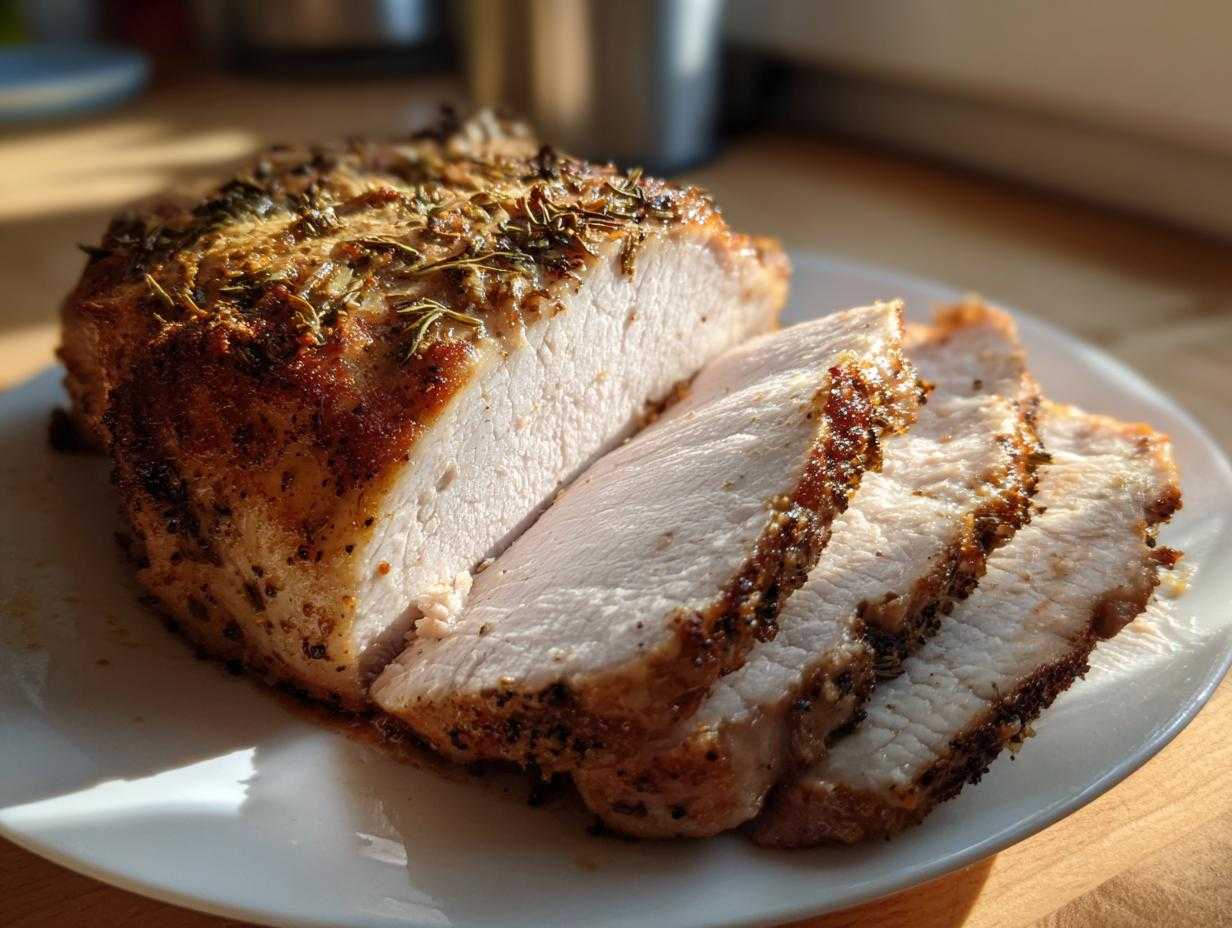
Man, there is nothing sadder than slicing into a beautiful roast only to realize it’s as dry as the dust bowl! We’ve all been there. But let me tell you, those days are over for us. I’m going to show you exactly how to nail a perfectly **juicy pork loin roast** every single time, using just a handful of pantry spices. It’s shockingly simple, which means you can absolutely make this for a busy weeknight dinner. When I was watching my Uncle in his kitchen down in Texas, he always stressed that even the simplest seasoning needed purpose, and this dry rub proves that precision beats complexity. This recipe guarantees you’ll have tender slices, whether you’re serving it up fast mid-week or presenting it proudly as your **Sunday roast recipe** centerpiece.
Why This Juicy Pork Loin Roast Is Your New Weeknight Dinner Favorite
I know what you’re thinking: ‘A roast? That sounds like it needs three hours and babysitting.’ Nope! That’s the beauty of this preparation. I developed this method because I needed an impressive **easy pork dinner** that didn’t demand an entire evening away from my projects. We’re talking about minimal active time here, folks. You mix the rub, slap it on, and let the oven do the heavy lifting. The secret to that unbelievably **juicy pork loin** isn’t complicated butter basting; it’s all about temperature control, which I walk you through later. Trust me, you’re going to want to save this one to your favorites. If you need more quick ideas for satisfying meals, check out my main Dinner Ideas collection!
Perfect for a Sunday Roast or Quick Weeknight Dinner
This recipe is the definition of versatile. If you have a quiet Sunday, this **sunday roast recipe** is a showstopper with minimal effort, letting you enjoy your day. But if Tuesday rolls around and you need dinner on the table fast, this pork loin is ready before soccer practice starts. It’s the **weeknight dinner** savior you didn’t know you needed!
Ingredients Needed for the Best Pork Loin Roast
When I say simple, I mean *simple*. We aren’t doing complicated marinades here! You just need a few kitchen staples to make this roast shine. Remember, the quality matters even when the list is short. For this particular **pork loin roast**, you’ll need a 3-pound bone-out cut, good olive oil, and a mix of kosher salt, pepper, garlic powder, and dried thyme. That’s it! See? Nothing scary about that list at all.
- 3 lb pork loin roast, bone-out
- 2 tablespoons olive oil
- 1 tablespoon kosher salt
- 1 teaspoon black pepper
- 1 teaspoon garlic powder
- 1 teaspoon dried thyme
Essential Equipment for Your Oven Roasted Pork
Listen, even simple seasoning needs the right tools to shine. You don’t need a fancy setup, but there are two items you absolutely cannot skip if you want that guaranteed tenderness. First, you need a sturdy roasting pan or a rimmed baking sheet—something to catch those glorious drippings for later! Second, and this is non-negotiable for E-E-A-T magic, you need a reliable instant-read meat thermometer. Guessing temperatures is how you end up with dry meat, and we aren’t doing that here!
- Roasting pan or rimmed baking sheet
- Meat thermometer (Seriously, get one!)
- Small mixing bowl
- Paper towels
Step-by-Step Instructions for a Tender Pork Loin Roast
Okay, this is where the magic happens, but don’t let the two different cooking temperatures scare you! This isn’t hard; it’s actually genius. Uncle used to say, “You treat the outside mean, then you treat the inside nice.” We’re following that philosophy exactly to lock in all those lovely juices. Make sure your **pork loin roast** is sitting out just long enough to take the deep chill off while you’re mixing your rub. Remember that step in the chicken recipe where I talked about patting things dry? It’s even more important here for getting that savory crust. If you’re looking for other ways to use great herbs, check out my thoughts on rubs for my Garlic Herb Chicken!
The High-Heat Sear for the Perfect Crust on Your Pork Loin Roast
First things first: get that oven cranked up to 425 degrees Fahrenheit! We’re blasting the roast for exactly fifteen minutes. This initial high heat does something wonderful—it sears the outside really fast. That dry, spiced exterior firms up instantly, creating a beautiful mahogany crust that traps all the moisture inside the meat. Don’t open that door during this time! Let that heat work its industrial magic on your **pork loin roast**; it’s preparing the surface for the gentle cook time that follows. We want that nice, brown, crispy bite, not pale, flabby pork!
Achieving the Ideal Pork Loin Internal Temp (145°F)
Once fifteen minutes are up, quickly but carefully drop that oven temperature right down to 350°F. You’re not done cooking; you’re just switching gears! Now, the thermometer comes out. You must insert it into the thickest part of the roast without touching any bone, if you have one. We are cooking this baby until it hits the official magic number: a **pork loin internal temp** of exactly 145 degrees Fahrenheit. Once that thermometer beeps or signals 145°F, pull it out immediately. Seriously, every degree over 145°F starts robbing you of that **juicy pork loin** texture we worked so hard for.

Crucial Resting Time for a Juicy Pork Loin Roast
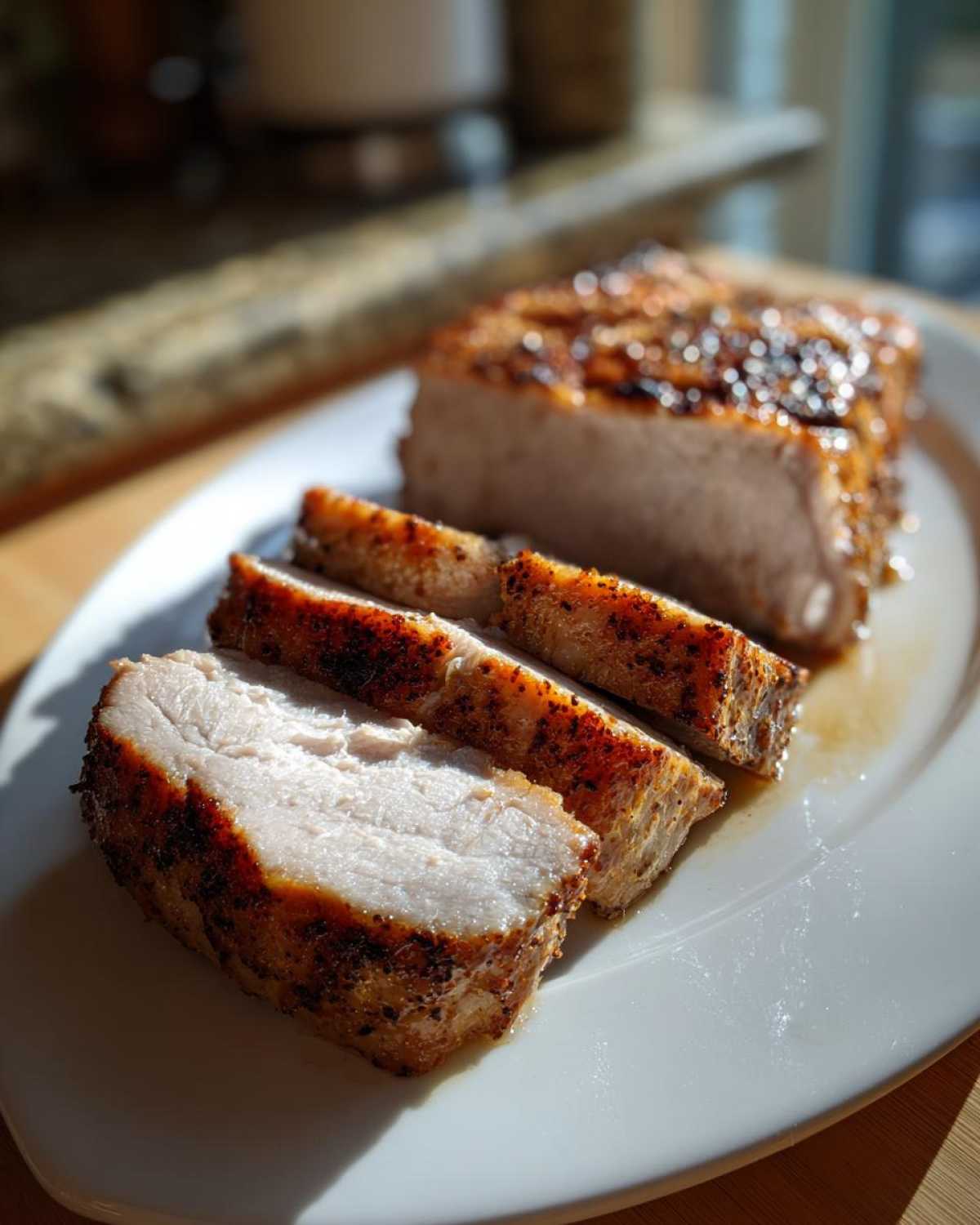
This next part is probably the hardest for me because I’m always starving, but you absolutely cannot skip it. Once the roast is off the heat at 145°F, move it to a clean cutting board and cover it loosely with foil—I mean tent it, don’t wrap it tight! Let it rest for a solid ten to fifteen minutes. This resting time allows the muscle fibers, which are all tight from the heat, to relax and redistribute those glorious juices throughout the meat. If you slice it right away, all that moisture runs out onto the board. Resting is the final secret step to an unbelievably **juicy pork loin**.

Tips for the Juiciest Pork Loin Roast Every Time
I’m going to hit you with a few more pointers—things I learned the hard way so you don’t have to! Achieving that melt-in-your-mouth texture in an **oven roasted pork** isn’t just luck; it’s about paying attention to detail where it counts. My uncle always said that the difference between an okay roast and one people rave about is the prep work five minutes before it hits the heat.
First, let’s talk about that rub again. Make sure you’re using your hands to press that seasoning mixture onto the meat. Don’t just sprinkle it from above! You want that salt and thyme mixture to really adhere to the olive oil coating. This ensures an even layer of flavor all around. If you have any bald spots, those areas will dry out faster in the oven.
The biggest tip, though, hinges on that thermometer usage. Don’t measure the temperature through the fat cap or close to the pan bottom. Always insert your meat thermometer into the very center and thickest part of where the roast comes together. If you’re worried about where the thickest part is, just visualize the cross-section—you want the direct center. This minor adjustment guarantees you pull that roast out at precisely the right moment, securing that fantastic **juicy pork loin** result we are aiming for.
Also, if your roast isn’t perfectly uniform—say, one end is thicker than the other—try tying it loosely with kitchen twine at equal intervals. This helps the roast cook more evenly, preventing the thinner ends from overcooking while you wait for the center to reach the target minimum **pork loin internal temp**.
Making a Simple Pan Sauce Gravy for Your Pork Loin Roast
Okay, you’ve rested the roast properly, and now your cutting board is covered in all those amazing, flavorful brown bits—that’s gold, friend! We are not wasting a single drop of that goodness. Turning those drippings into a quick **pan sauce gravy** is genuinely one of the easiest ways to elevate this roast from great to absolutely unforgettable. It finishes the meal perfectly, and honestly, it takes maybe five minutes once the pork is resting.
First, take your roasting pan *after* the roast is safely on the cutting board and put it right on your stovetop over medium heat. Yes, I know, heatproof pans only! Don’t worry about that beautiful garlic-herb crust sticking to the bottom—that’s flavor we need to capture. Using a wooden spoon or a spatula, start scraping up all those browned spots, mixing them right into the rendered fat. That’s the foundation of real flavor!
Once everything is lifted, you need liquid. Pour in about half a cup of broth—chicken or beef works fine. Let it bubble for a minute, scraping any stubborn bits still stuck on the bottom. If you want it thicker because you love a really hearty gravy, take a tablespoon of cornstarch and mix it with two tablespoons of cold water in a separate little bowl until smooth. This is your slurry. Pour that slurry into the simmering drippings slowly while stirring constantly. It will thicken up almost instantly! Taste it, adjust the salt if you need to, and bam! You have homemade **pan sauce gravy** ready to go. If you ever want to dive deeper into creamy sauces (though this is thin gravy-style), check out my recipe for Alfredo Sauce for some rich inspiration!
Storage and Reheating Instructions for Leftover Pork
I hope you have leftovers, because this roast is just as tasty the next day! Once completely cooled, you want to carefully store any leftover sliced meat in an airtight container. The key here is moisture retention. I recommend layering the slices with a tiny splash of broth or even just water between the layers. This prevents the edges from drying out in the fridge.

When you’re ready to eat the leftovers, resist the urge to microwave them on high! Low and slow is the way to go. Reheat gently in a skillet over low heat with a drizzle of that leftover pan sauce, or wrap the slices in a damp paper towel before microwaving them for just short bursts. This keeps them tender, not tough!
Frequently Asked Questions About Oven Roasted Pork
I get so many wonderful questions about roasting pork, and usually, they all boil down to timing and temperature! Don’t worry if you’ve been nervous about roasting before; we’re going to clear up all those last little bits of doubt. If you’re looking for other fantastic, easy sides to serve this with, maybe try looking at some of my lighter vegetable options while the roast is resting!
What is the safe minimum pork loin internal temp?
This is the most important question, really! USDA guidelines are very clear on this, and sticking to them means you’re safe to enjoy your meal. For any whole cut of pork, including this **pork loin roast**, the safe minimum **pork loin internal temp** you must reach is 145 degrees Fahrenheit. Remember, that’s when you take it *out* of the oven; it will carry over-cook slightly while resting, which is perfect!
How can I prevent my pork loin roast from drying out?
It all comes down to two steps we covered, but they bear repeating because they are the key to that guaranteed **juicy pork loin**! Number one: Use that quality meat thermometer religiously. Don’t guess! Pull it exactly at 145°F. Number two: You must respect the rest time. If you skip those 10 to 15 minutes of resting under foil, all those amazing juices flood out onto your cutting board instead of staying inside the meat fibers where they belong.
Can I use this recipe for a smaller pork loin roast?
Absolutely, but you have to adjust your timing! Since we use the 425°F blast for 15 minutes to set the crust, that part stays the same. After that, you reduce to 350°F. For a smaller roast—say, 2 pounds instead of 3—it will need less time per pound in the lower temperature phase. Always rely on the internal temperature reading, not the clock, but generally, start checking about 10 minutes sooner than you would for the full 3-pound cut. Slow and steady wins the race after the initial sear!
Sharing Your Perfect Pork Loin Roast
Well, friend, that’s it! You’ve made a centerpiece-worthy **oven roasted pork** that’s guaranteed tender. Now, I want to hear all about it! Did it look gorgeous? Did your family devour those perfectly seasoned slices? Please leave me a rating and a comment below telling me how your roast turned out. If you snap a photo, tag me! I love seeing Forkful Heaven recipes pop up in your kitchens—it truly makes my day. While you’re hanging out, maybe check out my pancake recipe for breakfast tomorrow!
Print
Juicy Oven Roasted Pork Loin Roast
- Total Time: 70 min
- Yield: 6 servings
- Diet: Low Fat
Description
Make a tender and juicy pork loin roast using simple ingredients and clear oven temperatures. This recipe is perfect for an easy weeknight dinner or a satisfying Sunday roast.
Ingredients
- 3 lb pork loin roast, bone-out
- 2 tablespoons olive oil
- 1 tablespoon kosher salt
- 1 teaspoon black pepper
- 1 teaspoon garlic powder
- 1 teaspoon dried thyme
Instructions
- Preheat your oven to 425 degrees Fahrenheit.
- Pat the pork loin roast completely dry with paper towels. This helps create a good crust.
- In a small bowl, mix together the kosher salt, pepper, garlic powder, and dried thyme.
- Rub the olive oil all over the pork loin roast.
- Sprinkle the spice mixture evenly over the entire surface of the pork, pressing gently so it adheres.
- Place the seasoned roast in a roasting pan or on a rimmed baking sheet.
- Roast at 425 degrees Fahrenheit for 15 minutes.
- Reduce the oven temperature to 350 degrees Fahrenheit. Continue roasting until the internal temperature reaches 145 degrees Fahrenheit on a meat thermometer inserted into the thickest part of the roast. This usually takes about 15 to 20 minutes per pound after the initial high-heat blast.
- Remove the pork loin roast from the oven when it hits 145 degrees Fahrenheit.
- Transfer the roast to a cutting board and tent it loosely with foil. Let it rest for at least 10 to 15 minutes before slicing. This resting period is key for a juicy pork loin.
- Slice against the grain and serve immediately. You can make a simple pan sauce gravy using the drippings.
Notes
- For the best results and a truly juicy pork loin, use a reliable meat thermometer to check the pork loin internal temp. 145 degrees Fahrenheit is the target.
- If you want a pan sauce gravy, place the roasting pan on the stovetop over medium heat after removing the roast. Scrape up any browned bits, add a splash of broth, and thicken with a cornstarch slurry.
- This recipe works well for a quick weeknight dinner or a traditional Sunday roast centerpiece.
- Prep Time: 10 min
- Cook Time: 60 min
- Category: Dinner
- Method: Oven Roasting
- Cuisine: American
Nutrition
- Serving Size: 4 oz cooked
- Calories: 280
- Sugar: 1
- Sodium: 450
- Fat: 12
- Saturated Fat: 4
- Unsaturated Fat: 8
- Trans Fat: 0
- Carbohydrates: 1
- Fiber: 0
- Protein: 40
- Cholesterol: 95


Comments are closed.